Blog / Two languages
Make your series in two languages: English and Spanish
If you make each episode in English and in Spanish, the same story can reach two very large audiences. Spanish has about 635 million speakers worldwide, according to the Instituto Cervantes, and the US alone has 68 million Hispanic people. Here is what to change between versions, how to post them and what to avoid.

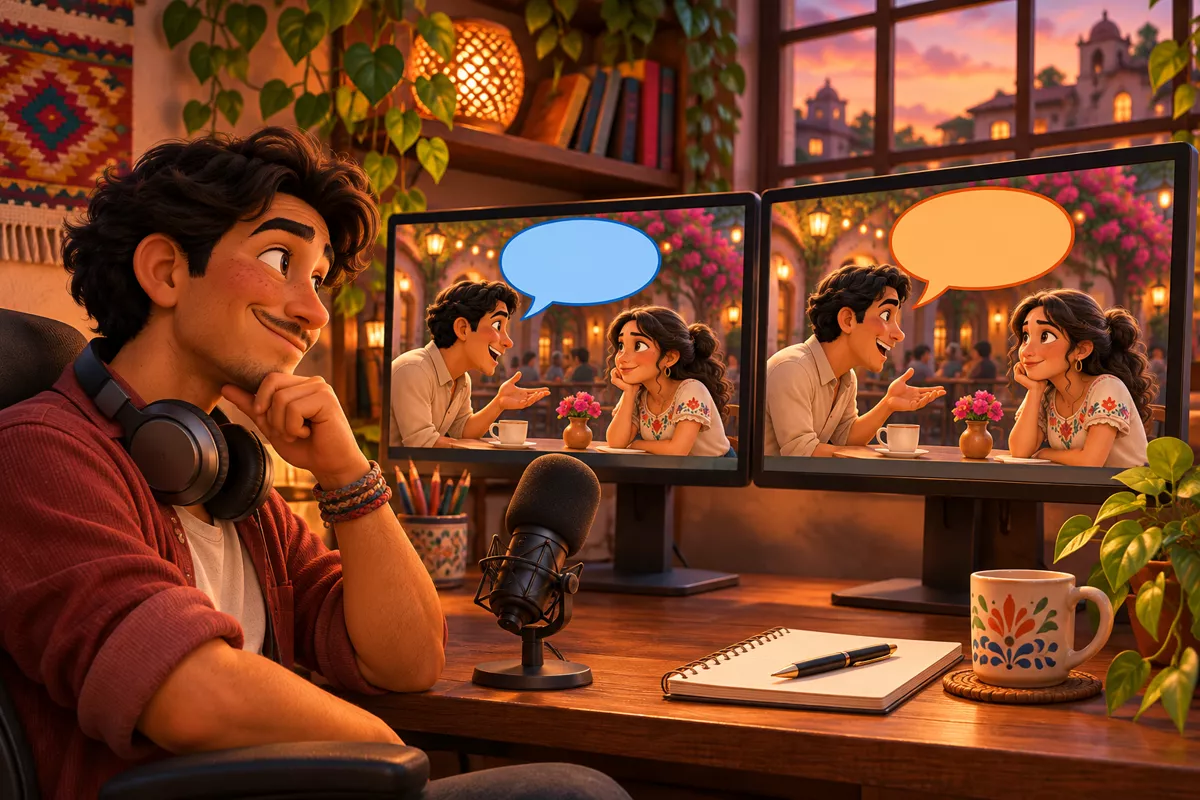
Your best idea is already written. A second language version reuses the same story and characters and opens a new audience.
In short
- Spanish has about 635 million speakers, 520 million of them native, according to the Instituto Cervantes 2025 yearbook.
- The US had 68 million Hispanic people in 2024, and 68% of Latinos speak Spanish at home, according to Pew Research Center.
- Latin America made 23% of short drama app downloads in early 2026, according to Sensor Tower.
- YouTube says creators who add audio in other languages got over 25% of their watch time from those languages.
- Adapt the episode, do not just translate it, and give each language its own account on TikTok and Instagram.
Why a second language is worth it
Most creators make one version and stop. But a story about a secret billionaire or a cheating husband works the same in Miami, Mexico City and Madrid. The people are different, the feelings are the same.
- Spanish speakers: about 635 million potential users and 520 million native speakers, according to the Instituto Cervantes yearbook "El español en el mundo 2025".
- United States: 68 million Hispanic people in 2024, 20% of the country, according to the Census Bureau and Pew Research Center. Pew also found that 71% of Latinos speak English well and 68% speak Spanish at home, so many watch in both languages.
- Drama apps: Latin America made 23% of all short drama app downloads in the first three months of 2026, according to Sensor Tower.
If you write in English, Spanish is the biggest second audience you can add. If you write in Spanish, English opens the market where people pay the most for short dramas.
What YouTube's numbers say
In September 2025 YouTube opened multi-language audio to all creators: one video, several audio tracks, and each viewer hears their own language. YouTube said that, on average, creators who uploaded these tracks got more than 25% of their watch time from views in the second language. It also said the feature tripled views on chef Jamie Oliver's channel.
These are YouTube's own numbers, so take them as a company report, not a promise. They still show that a second language finds people the first one misses. Check YouTube's help page to see whether the option appears on your channel.
YouTube's FREE Automatic Dubbing (multilingual & multi-track audio) (Video by Jeremy Chapman on YouTube)
Adapt, do not just translate
A word-for-word translation sounds strange in a drama. People notice right away. Change what needs to change:
- Lines: rewrite them the way people really talk. "You will regret this" may become "Te vas a arrepentir", not a stiff copy.
- Names and places: Ana can stay Ana, but a Texas ranch may work better as a hacienda in the Spanish version.
- Jokes and insults: they rarely translate. Write a new one that hits the same way.
- Money and details: dollars, euros or pesos, depending on who you want to reach.
- Captions: always in the same language as the voice. Many people watch with the sound off.
Spanish also changes by country. Choose one neutral Spanish for the whole series, or pick one country and write for it.
How to make both versions with BeDigitaly
When you create an episode with the agent, you choose its language. The characters and places stay saved, so for the second version you ask for the same episode in the other language with the same cast. Each version is its own episode, so it has its own price, shown before you pay.
A simple way to start: make the first three episodes in both languages, post them, and see which version people finish more. Then decide if you keep both for the whole season.
How to post each version
On TikTok and Instagram, a separate account for each language usually works better. The apps show videos to people based on what they watch, and an account that mixes two languages confuses both audiences.
- Give both accounts the same name with a language tag, like "the series name" and "the series name en español".
- Write the description and hashtags in the language of each version.
- Post at the hours of each audience: US time zones for English, Mexico, Colombia or Spain for Spanish.
- On YouTube, one channel with multi-language audio can be enough, if the option is available for you.
- Do not upload the exact same video twice on the same account. Check each network's rules on repeated content.
Mistakes to avoid
These are the ones that make a second version fail:
- Using a machine translation without reading it out loud.
- Changing the characters' looks or names between versions, so fans who watch both get lost.
- Releasing the second version weeks later, when the first one has already been forgotten.
- Forgetting captions in the second language.
One thing to do today
Take the first line of your episode 1 and write it in the other language the way a person from there would really say it. Read both out loud. If the second one sounds natural, you are ready for the second version.
Questions
Is it better to have one account or two for two languages?
On TikTok and Instagram, two accounts usually work better. On YouTube, one channel with audio in several languages can be enough.
Do I need to speak both languages?
It helps a lot. If you do not, ask a native speaker to read the script before you create the episode.
Which Spanish should I use?
A neutral Spanish reaches the most countries. If your audience is mostly in one country, write for that country.
Does the second version cost the same?
Each version is its own episode, so it has its own price. The app shows it before you pay.
Can I just add captions in the other language?
You can, and it is a good first step. A version with voices in that language usually feels more natural to watch.
One story, two audiences
Make your first episode in one language, then ask the agent for the other. Same characters, new audience.